

Summary
The history of dental implants demonstrates how far dentistry has come. From ancient attempts using basic materials to today's sophisticated titanium implants and full-arch solutions, implant dentistry has developed through centuries of learning and innovation.
The History of Dental Implants: From Ancient Ideas to Modern Tooth Replacement
The idea of replacing missing teeth is much older than modern dentistry. For thousands of years, people have looked for ways to restore lost teeth and improve their ability to eat and speak. What began with simple and sometimes unusual attempts eventually developed into the advanced dental implant treatments available today.
The history of dental implants is a story of experimentation, discovery, and improvements in dental science. Today’s implants are the result of many generations of dentists, surgeons, researchers, and patients helping shape the field.
Early Attempts to Replace Missing Teeth
Long before modern dental implants existed, ancient civilizations tried to replace missing teeth using materials available to them.
Archaeological discoveries have shown that some ancient people used pieces of bone, ivory, animal teeth, and other materials as tooth replacements. These early attempts were very different from modern implants, but they show that replacing missing teeth has been a concern for centuries.
Some ancient dental replacements were placed directly into the mouth after a tooth was lost. Without today’s understanding of infection, bone healing, and surgical techniques, these methods had limited success.
Still, these early efforts introduced an important idea: a missing tooth could potentially be replaced with something artificial.
Dental Innovation During the 1700s and 1800s
As dentistry became more established, dentists began experimenting with different materials and designs for replacing teeth.
During the 1700s and 1800s, researchers explored materials such as gold, porcelain, and various metals. Dentists also developed different types of artificial teeth and methods for securing them.
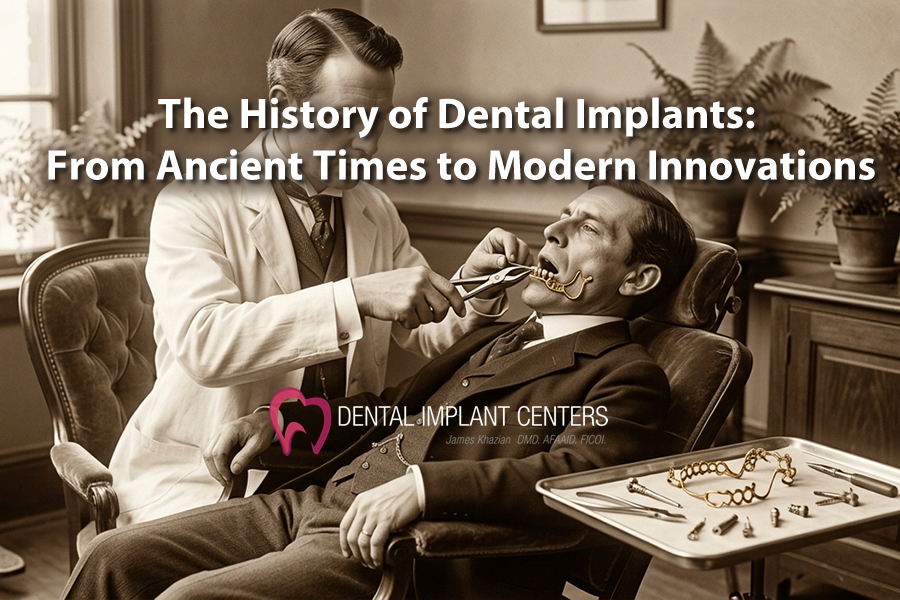
Some early implant attempts involved placing metal or other materials into the jaw. Unfortunately, many of these efforts failed because the materials and surgical techniques were not yet advanced enough to work reliably with the human body.
The problem was not simply creating an artificial tooth. Researchers needed to discover how to create a stable connection between the replacement and the jaw.
The Importance of Biocompatibility
One of the major challenges in the history of dental implants was finding a material that the human body could tolerate.
An implant needs to remain stable inside the jaw without causing significant problems for the surrounding tissues. Researchers gradually learned more about how bone responds to different materials.
Titanium eventually became one of the most important materials in implant dentistry because of its strength, durability, and ability to integrate with bone.
This discovery helped change the future of dental implant treatment.
The Discovery of Osseointegration
A major turning point came in the 20th century through the work of Swedish physician and researcher Per-Ingvar Brånemark.
During research involving bone healing, Brånemark observed that titanium could form a strong connection with living bone. He called this process osseointegration.
This discovery became a foundation of modern dental implantology.
Instead of simply placing an artificial tooth into the mouth, dentists could use a titanium implant as an artificial tooth root. Over time, the surrounding bone could integrate with the implant and provide stability.
This was a significant step toward the dental implants used today.
The Development of Modern Dental Implants
As research continued during the second half of the 20th century, dental implants became more predictable.
Implant designs improved, surgical techniques became more precise, and dentists gained a better understanding of bone healing and oral health. Researchers also developed improved implant surfaces and restoration materials.
Dental implants could now be used for different situations, including replacing a single missing tooth, supporting bridges, or securing replacement teeth for patients with extensive tooth loss.
The development of better diagnostic technology also helped dentists plan implant treatment more carefully.
The Rise of Full-Arch Implant Treatment
Another important development was the use of dental implants to support an entire arch of replacement teeth.
Instead of replacing every missing tooth with an individual implant, dentists developed treatment approaches that could use a smaller number of strategically positioned implants to support a full set of replacement teeth.
One well-known example is the All-on-4® treatment concept. This approach uses four implants to support a full arch of replacement teeth in appropriate patients.
Full-arch implant treatment has provided another option for people who have lost most or all of their teeth.
Dental Implants Today
Modern dental implant treatment is very different from the early attempts made centuries ago.
Today, dentists and oral surgery professionals can use detailed examinations, digital imaging, advanced planning techniques, and carefully designed restorations to create individualized treatment plans.
Dental implants can be used for many different situations, including:
- Replacing one missing tooth
- Replacing several missing teeth
- Supporting a dental bridge
- Securing dentures
- Restoring an entire arch of teeth
- Supporting full-mouth dental restorations
The treatment chosen depends on factors such as the patient’s oral health, jawbone condition, number of missing teeth, and overall treatment goals.
The Future of Dental Implant Dentistry
The history of dental implants is still being written. Research continues to explore improved implant materials, better surface treatments, digital planning, 3D imaging, and more efficient treatment techniques.
Technology is also changing the way dental professionals plan implant placement and design replacement teeth. These developments may continue to make treatment more precise and personalized.
However, the basic goal remains the same as it was centuries ago: finding a dependable way to replace missing teeth and restore oral function.
Final Thoughts
The history of dental implants demonstrates how far dentistry has come. From ancient attempts using basic materials to today’s sophisticated titanium implants and full-arch solutions, implant dentistry has developed through centuries of learning and innovation.
Modern dental implants offer patients a stable way to replace missing teeth and restore important functions such as chewing and speaking. While today’s technology is far more advanced than the methods used in the past, the goal has remained remarkably consistent: helping people regain a complete, functional, and confident smile.
For more information about dental implants, all-on-4, all-on-6, bone grafts, sinus graft, full mouth reconstruction, snap on dentures, and cosmetic dentistry, you may request a free consultation with Dr. James Khazian by clicking here or call 866-4my-smile (866-469-7645).