

Summary
Dental implants are not a one-size-fits-all treatment. From traditional endosteal implants to advanced solutions like zygomatic and All-on-4® implants, modern dentistry offers options for nearly every situation.
Dental implants have become one of the most reliable and long-lasting solutions for replacing missing teeth. Unlike dentures or bridges, dental implants are designed to replace the tooth root as well as the visible crown, providing strength, stability, and a natural appearance. However, not all dental implants are the same. There are several main types of dental implants, each designed to meet different oral health needs, bone conditions, and treatment goals.
Understanding the main types of dental implants can help you feel more confident and informed when discussing treatment options with your dentist.
1. Endosteal Dental Implants
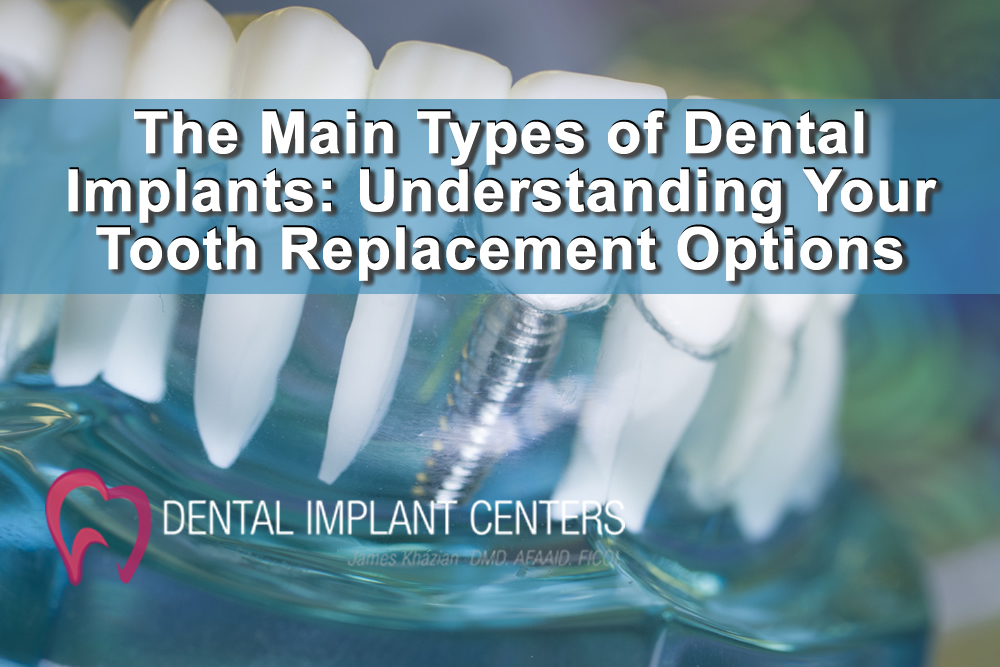
Endosteal implants are the most commonly used type of dental implant today. These implants are placed directly into the jawbone and act as artificial tooth roots.
They are typically shaped like small screws or cylinders and are most often made from titanium, a biocompatible material that bonds well with bone. Once placed, the implant integrates with the jawbone through a process known as osseointegration. After healing, a crown, bridge, or denture is attached to restore function and appearance.
Who they’re best for:
Endosteal implants are ideal for patients with healthy gums and sufficient jawbone density. They are commonly used for replacing single teeth, multiple teeth, or as part of full-arch restorations.
Why they’re popular:
They offer excellent stability, a natural feel, and a high long-term success rate.
2. Subperiosteal Dental Implants
Subperiosteal implants are placed on top of the jawbone but underneath the gum tissue, rather than being embedded into the bone itself.
Instead of a screw-like implant, this type uses a metal framework that rests on the jawbone. Posts from the framework extend through the gums to support replacement teeth once healing is complete.
Who they’re best for:
Subperiosteal implants may be considered for patients who have insufficient bone height and are not candidates for bone grafting or prefer to avoid additional surgical procedures.
Important note:
While effective in certain cases, subperiosteal implants are less commonly used today due to advances in bone grafting and implant technology.
3. Zygomatic Dental Implants
Zygomatic implants are a specialized option used in complex cases, particularly when there is severe bone loss in the upper jaw.
Rather than anchoring into the jawbone, these implants are placed into the cheekbone (zygoma), which is naturally dense and provides strong support. Because of their length and placement, zygomatic implants require advanced training and surgical expertise.
Who they’re best for:
Patients with significant upper jaw bone loss who are not candidates for traditional implants without extensive bone grafting.
Why they’re unique:
They can eliminate the need for bone grafting and may allow for faster restoration in select cases.
4. All-on-4® Dental Implants
The All-on-4® technique is a modern implant solution designed for patients who are missing most or all of their teeth.
Instead of placing an implant for every missing tooth, four strategically positioned implants are used to support a full arch of fixed replacement teeth. The back implants are angled to maximize bone contact, often eliminating the need for bone grafting.
Who they’re best for:
Patients with complete tooth loss, failing teeth, or those transitioning from dentures to fixed teeth.
Key benefit:
In many cases, patients can receive implants and a set of temporary teeth on the same day, often referred to as “Teeth in a Day.”
5. Mini Dental Implants
Mini dental implants are smaller in diameter than traditional implants and are used in specific situations.
They are often placed using a less invasive technique and may be used to stabilize dentures or replace small teeth in areas with limited space.
Who they’re best for:
Patients with limited bone density or those seeking a less invasive option for denture stabilization.
Consideration:
While useful in certain cases, mini implants may not offer the same long-term durability as standard implants for all situations.
Choosing the Right Type of Dental Implant
The best type of dental implant depends on several factors, including:
- Bone density and jaw structure
- Number of missing teeth
- Overall oral and general health
- Treatment goals and lifestyle
- Budget and timeline
A comprehensive evaluation, including imaging and a detailed oral examination, is essential before deciding on an implant solution.
Final Thoughts
Dental implants are not a one-size-fits-all treatment. From traditional endosteal implants to advanced solutions like zygomatic and All-on-4® implants, modern dentistry offers options for nearly every situation. Understanding the main types of dental implants empowers patients to make informed decisions and work with their dentist to choose the most effective and lasting solution.
With the right implant type and proper care, dental implants can restore function, confidence, and quality of life for many years to come.
For more information about dental implants, all-on-4, all-on-6, bone grafts, sinus graft, full mouth reconstruction, snap on dentures, and cosmetic dentistry, you may request a free consultation with Dr. James Khazian by clicking here or call 866-4my-smile (866-469-7645).